
A Jew's view from the capital of Israel and the future site of the Third Temple, may it speedily be rebuilt.
Stats
Showing posts with label Rav Tzvi Yehuda Kook. Show all posts
Showing posts with label Rav Tzvi Yehuda Kook. Show all posts
Tuesday, November 10, 2020

Monday, March 10, 2014
Haredim and the Mitzvah to Serve in the IDF
Here is a discussion, based on halachic sources, on the mitzvah to serve in the Israeli Defense Force. A taste:
The mitzvah to enlist in the army is based on two great mitzvoth – haztalat Yisrael (saving Israel), and yishuv ha’aretz (settling the Land of Israel). It should be noted that seventeen mitzvoth from the Torah relate to the army, as listed by Rabbi Zevin in his book ‘L’Ohr Ha’Halakha’, where he thoroughly clarifies the mitzvah to enlist in the army. This issue was also expounded upon at length by Tzitz Eliezer, Rabbi Tzvi Yehudah HaKohen Kook in his book ‘L’Nityvote Yisrael’, and other gedolei Torah.
Thursday, May 30, 2013
A Test for Yirat Shamayim (The Fear of Heaven)
I heard the following story from a well known rabbi here in Jerusalem recently:
When I was a young man and still a bachelor, I met a girl that I was really enthusiastic about. I was seriously considering marrying her. She was a religious girl, but a certain doubt was preventing me from popping the question: How do I know if she is truly God fearing?So there you have it! A good way to differentiate between one who is "religious" and one who truly fears God is to check how he/she relates to Torah scholars.I decided to consult my master and teacher, Rabbi Tzvi Yehudah HaKohen Kook zt"l. After presenting my question, he told me, "See what her attitude is regarding Torah scholars. This will give you a good indication as to whether she is truly a God fearing person."
Armed with this piece of advice I met this girl once again. I asked her, "What do you think of Rabbi X?"
"He's senile", she answered.
"And what about Rabbi Y?" I continued.
"Rabbi Y? Such, a primitive person!"
Needless to say that this was the last time that we went out.
Thursday, March 27, 2008
Parshat Parah: Holy Hyssop!
Every so often I am reminded how fortunate I am to have made my home here in Israel. I mentioned in a previous post that here the Torah comes to life. As I was walking through the Jerusalem forest my eyes spotted something that you just don't see in Monsey or Borough Park:
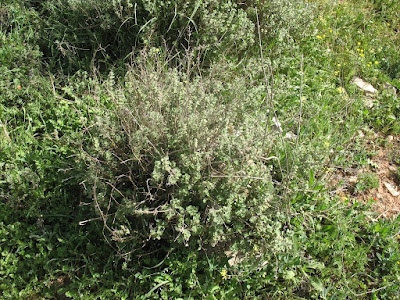
This is the shrub that is commonly known by its name in Arabic, za'atar. The Hebrew word for it is Eizov, and is usually translated to English as hyssop. Nowadays it is commonly used as a spice. The hyssop is mentioned in this week's special Torah reading, parshat parah. It is used to sprinkle the mixture of the ashes of the red heifer and water on whatever needs to be purified(Numbers Chapter 19):
Rav Tzvi Yehudah Kook zt"l used to point out that from the haftarah of parshat parah (Ezekiel Chapter 36) we learn that the Jewish Diaspora is a desecration of God's name:
Rashi explains the diaspora is a desecration of God's name because in the eyes of the nations it is as if God lacks the ability to save His people and His land.
This desecration of the Divine Name cannot last forever:
In contrast to the diaspora, kibbutz galuyot, the ingathering of the exiles, is a sanctification of God's name:
But this is not all:
This prophecy reminds me of what King David prayed(Psalms Chapter 51):
May we all merit to see the fulfillment of Ezekiel's prophecy. Shabbat Shalom.
Update: I read in one of the parasha sheets that the hyssop is now a protected species in Israel, i.e. you are not allowed to pick it in the wild.
Tzvi Fishman also blogged Ezekiel 36, and ruffled a few feathers as usual.

This is the shrub that is commonly known by its name in Arabic, za'atar. The Hebrew word for it is Eizov, and is usually translated to English as hyssop. Nowadays it is commonly used as a spice. The hyssop is mentioned in this week's special Torah reading, parshat parah. It is used to sprinkle the mixture of the ashes of the red heifer and water on whatever needs to be purified(Numbers Chapter 19):
And for the unclean they shall take of the ashes of the burning of the purification from sin, and running water shall be put thereto in a vessel. And a clean person shall take hyssop, and dip it in the water, and sprinkle it upon the tent, and upon all the vessels, and upon the persons that were there, and upon him that touched the bone, or the slain, or the dead, or the grave. And the clean person shall sprinkle upon the unclean on the third day, and on the seventh day; and on the seventh day he shall purify him; and he shall wash his clothes, and bathe himself in water, and shall be clean at even.
Rav Tzvi Yehudah Kook zt"l used to point out that from the haftarah of parshat parah (Ezekiel Chapter 36) we learn that the Jewish Diaspora is a desecration of God's name:
And I scattered them among the nations, and they were dispersed through the countries; according to their way and according to their doings I judged them. And when they came unto the nations, whither they came, they profaned My holy name; in that men said of them: These are the people of the LORD, and are gone forth out of His land.
Rashi explains the diaspora is a desecration of God's name because in the eyes of the nations it is as if God lacks the ability to save His people and His land.
This desecration of the Divine Name cannot last forever:
But I had pity for My holy name, which the house of Israel had profaned among the nations, whither they came.
In contrast to the diaspora, kibbutz galuyot, the ingathering of the exiles, is a sanctification of God's name:
Therefore say unto the house of Israel: Thus saith the Lord GOD: I do not this for your sake, O house of Israel, but for My holy name, which ye have profaned among the nations, whither ye came. And I will sanctify My great name, which hath been profaned among the nations, which ye have profaned in the midst of them; and the nations shall know that I am the LORD, saith the Lord GOD, when I shall be sanctified in you before their eyes. For I will take you from among the nations, and gather you out of all the countries, and will bring you into your own land.
But this is not all:
And I will sprinkle clean water upon you, and ye shall be clean; from all your uncleannesses, and from all your idols, will I cleanse you. A new heart also will I give you, and a new spirit will I put within you; and I will take away the stony heart out of your flesh, and I will give you a heart of flesh. And I will put My spirit within you, and cause you to walk in My statutes, and ye shall keep Mine ordinances, and do them. And ye shall dwell in the land that I gave to your fathers; and ye shall be My people, and I will be your God.
This prophecy reminds me of what King David prayed(Psalms Chapter 51):
Purge me with hyssop, and I shall be clean; wash me, and I shall be whiter than snow.
Make me to hear joy and gladness; that the bones which Thou hast crushed may rejoice.
Hide Thy face from my sins, and blot out all mine iniquities.
Create me a clean heart, O God; and renew a steadfast spirit within me.
May we all merit to see the fulfillment of Ezekiel's prophecy. Shabbat Shalom.
Update: I read in one of the parasha sheets that the hyssop is now a protected species in Israel, i.e. you are not allowed to pick it in the wild.
Tzvi Fishman also blogged Ezekiel 36, and ruffled a few feathers as usual.
Wednesday, July 18, 2007

Subscribe to:
Posts (Atom)